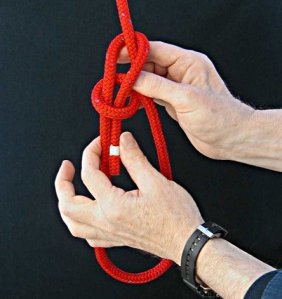
How to tie a Bowline with your left hand – Updated

A Bowline tied with your left hand

A Bowline tied with your left hand

Tying a Bowline is an essential boating skill  but one that seems to stump many boaters, then when you add being left handed to the mix things can get really confusing so I made this guide to help left handed people tie a Bowline.

A few years ago while helping to teach knot tying at the Mountaineers Sailing Crew Class I noticed that many of the students were left handed and really struggling with tying the Bowline.

I then taught myself to tie the Bowline with my left hand and this helped as I could now demonstrate how to tie a Bowline with my left hand and letting them look over my left shoulder did help quite a bit.  But as with all teaching, doing something in class and being able to do the same task once a student got home were two very different things. Continue reading
Posted in Boating Safety, Sailing and Boating Skills | Tagged , , , , , , | 8 Comments

Cell Phone Overboard

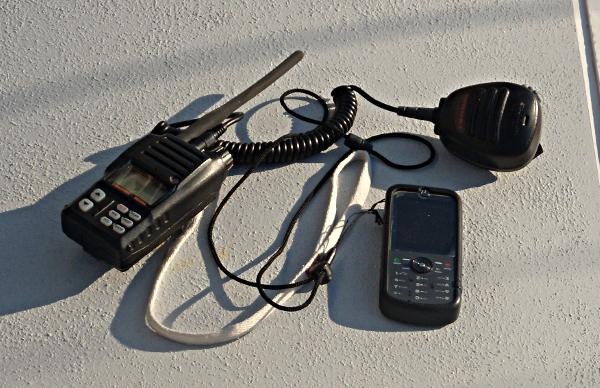
Cell-Phone and vhf radio

Cell phone and VHF Radio with safety lanyards.

2011 seemed to be the year of the “Cell Phone Overboard” event.  I received several emails, phone calls from land lines, smoke signals at public event and such explaining the cell phone had went into the water and they needed my phone number or other information they had stored on their cell phone.

One email even had a long engineering calculation showing how thick the ice should have been to support their cell phone when dropped from a given height (god bless  Mechanical Engineers).

I thought that this would be a good time to share a few tips and tricks that I and some of my friends use to prevent the cell phone overboard drill.

Continue reading

Posted in Boating Safety, Sailing and Boating Skills | Tagged , , | 4 Comments

The National Aids to Navigation Museum

aids to navigation museum

2nd Order Fresnel Lens, over 7 ft tall, displayed a flashing light and in 1934 the light was reportedly seen a record 53.6 miles away. (image from the video)

The National Aids to Navigation Museum is located in Yorktown, Virginia at the USCG Training Center, in the atrium of Canfield Hall.  The Museum is open to everyone that has access to the base, this sadly limits the access by the public (they do say that limited access tours may be available to groups with prior notice), I found this short video tour of the Museum online for those that can’t travel back to the east coast or don’t have access to get onto a U.S. Coast Guard base.

The use of lighted manned Aids to Navigation go back almost 300 years in the U.S with the first lighthouse keepers beginning in 1716.  Lighted ATON’s (Aids to Navigation) have come a long way since the first fires were lit on raised platforms.

Read More and watch the video

Posted in Boating Safety, Navigation | Tagged , , | Leave a comment

Aids to Navigation–Class Aids

Making aids to navigation class aids

Making aids to navigation class aids

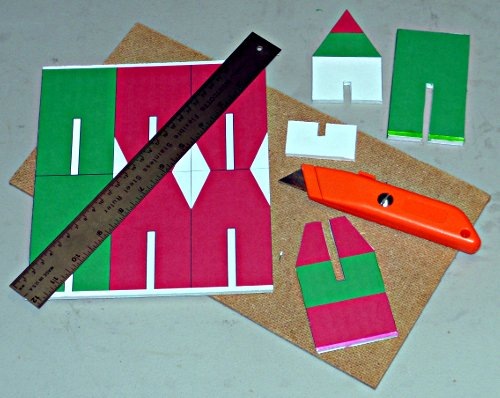
Students seem to struggle the most with the Aids to Navigation section when first learning about Boating Safety.  Most texts have simple diagrams and a few pictures but putting everything in context is difficult.  These teaching aids for Aids to Navigation seem to help.  The teaching aids are designed to be placed on a table top so students can move around the table and view the Aids to Navigation from different view points and move the ATON’s around on the table to see different views and courses.  Most of the Aids to Navigation class aids are about 4.25 inches tall.

These work nice as a hands on lab after the class has covered the Aids to Navigation section of the text.  I have also  produced a short narrated PowerPoint video that shows pictures of Aids to Navigation and the chart symbols with a section of the actual chart that works well but a hands on lab after the PowerPoint presentation seems to reinforce the learning. (U.S. Aids to Navigation presentation) The instructor notes are also very complete.

Continue reading

Posted in Boating Safety | Tagged , , , , | 6 Comments

U.S. Aids to Navigation

Aids-to-Navigation

U.S. Aids to Navigation

Understanding what an Aid to Navigation (ATON) means is a very important part of Safe Boating.  One of the problems understanding what each Aid to Navigation means is visualizing what a specific ATON looks like and match it to the symbol on a chart.  I have taken pictures of Aids to Navigation in the Seattle area and matched the ATON pictures up with the chart they are on and the symbol from the navigation chart.

There is only one Aid to Navigation per page to help boaters visualize clearly what each ATON looks like and to put the Aid to Navigation in the proper context on the chart and what the ATON means for safe boating.   The instructor notes are also included at the bottom of this article.

Continue reading

Posted in Boating Safety, Navigation, Sailing and Boating Skills, seattle | Tagged , , , , | 3 Comments

Jules Vern Trophy Attempt

on-board-Maxi-Banque-Populaire-V

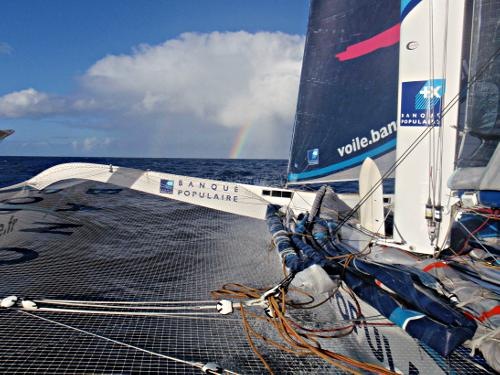
Photo of Banque Populaire V from the Banque Populaire V press site.

I have been watching the latest attempt at the Jules Vern Trophy by the Banque Populaire V a  Maxi trimaran 131 feet in length  for the last few days and it is beyond comprehension.  Banque Populaire V is running ahead of the current record holder Groupama 3 by over 1,500 miles with a few days left if they hold this pace to the finish line.

The rules are simple sail from France and leave the three major Capes to Port (Good Hope, Leeuwin, and Horn) and if you hit an iceberg or whale it sure would be bad for your time.   In one of the first notes I read from the boat they were lamenting that they had “slowed down to only 20 knots.”  The boat had some speeds in the mid 40 knot range, beyond my imagination.

Continue reading

Posted in Racing | Leave a comment

TVMDC – Practice – Correcting and un-correcting the compass

TVMDC – Practice – Correcting and un-correcting the compassIn today’s increasing use of electronic navigation aids, the ability to correct and un-correct a compass heading or bearing seems to becoming a lost art outside of a classroom.  Here are a few TVMDC Practice Problems to help keep your navigation skills sharp.

“Correcting” is converting a magnetic (M) direction to true (T). “Un-correcting” is converting from true to a magnetic direction. “True” direction is relative to true north (north pole). Continue reading

Posted in Boating Safety, Navigation, Safety Thoughts, Sailing and Boating Skills | Tagged , , , , , | 13 Comments

The New Table

New-Boat-Table

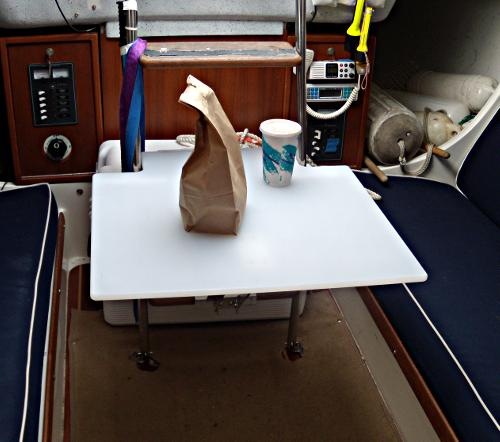
The new table - ready for lunch

This is the new table I built for my boat.  My boat did not come with a cabin table which made eating below a bit of an adventure.  Some food was balanced a bit on the steps of the ladder, some on the top of the cooler and yet more sort of scattered around wherever there was an open space.   All in all a bit of an awkward solution.

I thought of many ways to do the table, some were long down the center of the cabin, others had legs that would be in the way or would have been easy to tip over.  My 23rd redesign was a two foot square table the hooked on the middle step of the companion way ladder and was held up with an angle brace to the step below it.

Continue reading

Posted in Boat Maintenance, Boating Safety | Leave a comment