Chafe Protection – Or keeping your boat tied up in a storm

chafe protection

What can happen if proper chafe protection is not used

As the fall storms and winds increase, chafe protection on mooring lines is often overlooked until a line parts or breaks.

Lines should be protected anytime they go over or around a sharp or abrasive object.

Chafe is increased anytime a line passes over a rough spot, inspect all line contact areas for rough, abraded areas, nicks, scratches, or groves.  In some cases edges can be rounded or relieved to help reduce chafe.

Commercial chafe protection and gear comes in almost infinite choices or you can make your own chafe guard without too much difficulty.

Continue reading

Posted in Boat Maintenance, Boating Safety, Sailing and Boating Skills | Tagged , , , , | 3 Comments

How To Tie The Sheet Bend and Double Sheet Bend

Sheet Bend - Double Sheet Bend

Double Sheet Bend

The Sheet Bend / Double Sheet Bend is used to fasten two lines together of different diameters.  But it can also be used to fasten two lines together of the same size.

The Sheet Bend / Double Sheet Bend is quick and easy to tie.  If the larger line is quite a bit larger than the smaller line or the larger line is stiff then the Double Sheet Bend should be used and the end of the bight in the larger line should be tied to itself to keep it from straightening out and becoming undone.

When tied in the end of a line with a loop in it, it becomes a Becket Bend.  The Becket Bend it tied exactly the same.

The difference between a Sheet Bend and Becket Bend makes a good trivia question from time to time.

Since the two knots are tied so close to the same, I have merged the instructions for both of them below.  I hope this does not confuse anyone.

Continue reading

Posted in Boating Safety, Sailing and Boating Skills | Tagged , , , , | Leave a comment

Flashlights For The Boat

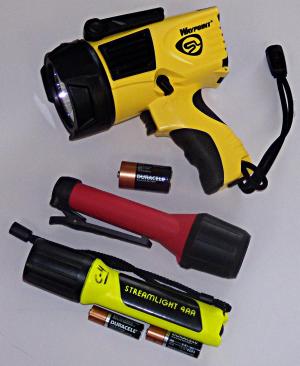
Top to bottom, Streamlight Waypoint LED Flashlight, Streamlight 4AA ProPolymax LED Flashlight and Streamlight 4AA ProPolymer Lux LED Flashlight

Top to bottom, Streamlight Waypoint LED Flashlight, Streamlight 4AA ProPolymax LED Flashlight and Streamlight 4AA ProPolymer Lux LED Flashlight

As the days get shorter, the odds that you will be returning to your slip or  entering the marina at night are increasing.

Entering many marinas after dark can be a real stressful experience, here are three lights that I have added to my after dark tools over the last year  that can help make entering a marina as well as other after dark boating much safer.

Some marinas are poorly lighted and even going down your home fairway can be stressful and finding the right slip is many times very difficult.

The three lights that I have added all have different characteristics and each offers different strong points, match the light to the need.  They are different power, some are easier to carry, provide longer battery life or reach out farther.

All of these will reach out if you need to signal for help or signal another vessel that does not seem to be aware of your presence.  A note on the use of lights to signal another vessel, you are not allowed to shine a light into the pilothouse or the eyes of the people driving the other vessel, that can ruin their night vision and is unsafe.  Shine the light on the water in the direction of the other vessel, you can also shine a light on the side of your vessel or the sails if you have sails up to attract attention.  Two of the lights have a strobe mode that is real annoying and should attract lots of attention at night.

Continue reading

Posted in Boating Safety | Tagged | 6 Comments

New autonomous surface vehicles to deliver shoaler depth measurements for NOAA nautical charts

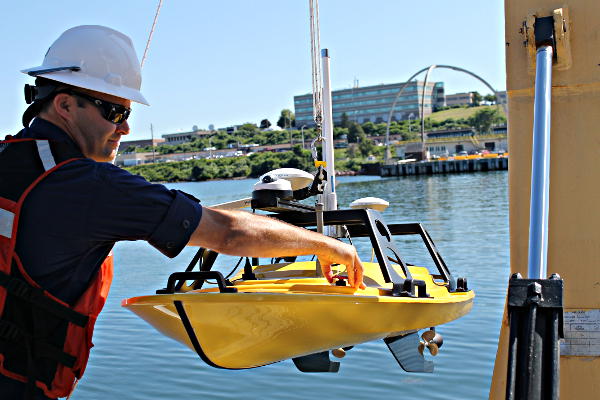
Lt. Joseph Carrier, operations officer on NOAA Ship Thomas Jefferson, deploys a Z-Boat from the ship. Photo Credit NOAA

Lt. Joseph Carrier, operations officer on NOAA Ship Thomas Jefferson, deploys a Z-Boat from the ship. Photo Credit NOAA

Great news from NOAA for anyone boating in shallow water.

If you look closely at any U.S. coastal nautical chart, you’ll likely find that the areas closest to the shore, shoals, and rocks do not have updated depth measurements. In many areas, safety concerns prohibit the use of NOAA ship or launches to survey the shoalest depths. In many areas, the water is too murky to be mapped with the airborne lidar systems used in clear waters. Now, however, charting those shallow areas is about to get safer, thanks to recent purchases of small, commercial off-the-shelf, unmanned survey vessels.

This summer, NOAA Ship Thomas Jefferson will deploy a “Z-Boat,” offered by Teledyne Oceanscience out of Carlsbad, California.

Continue reading

Posted in Boating Safety, Navigation, Safety Thoughts | Tagged | 3 Comments

An Evening Sail on the America’s Cup Yacht America

Yacht America getting ready for an evening sail from the Bell Harbor Marina in Downtown Seattle

Yacht America getting ready for an evening sail from the Bell Harbor Marina in Downtown Seattle

Last week I took an evening sail in Seattle on the Yacht America, a replica of the boat that won the trophy that would become know as the America’s Cup.

The wind in Elliot Bay was nice with 8 to 10 knots at West Point, moving America smartly along at 8 to 9 knots on a bit of a reach over to Bainbridge Island and back, the water was flat for a very nice trip.

The weather was a bit chilly on the water and a few people did not bring coats, the crew of America were gracious hosts and got out spare blankets for the guests to wear.

As with many ships of this type the guests became the crew (the adventure, historic ambiance and team building I am told) when it was time to raise the sails, with a main mast of 105 feet and setting 5,900 square feet of sail in four sails, it takes a lot of work to raise the sails.  If the weather is right guests are invited to drive the boat if they want.  Several stepped up and got to drive the America under the watchful eye of Captain Troy.  The calm guidance of Captain Troy was great given the look of concentration or terror at times on the face of those that drove the boat.

Continue reading

Posted in History | Tagged , , | Leave a comment

2014 Boating Accidents & How You Can Reduce Your Risk Of Having An Accident

Crewmembers aboard a 45-foot Response Boat-Medium, from Coast Guard Station Charleston, S.C., approach an overturned boat, July 13, 2015, approximately 12 miles off the Charleston coast. The boat was found during a search for four overdue boaters who were later rescued by Station Charleston crews. (U.S. Coast Guard photo)

Crewmembers aboard a 45-foot Response Boat-Medium, from Coast Guard Station Charleston, S.C., approach an overturned boat, July 13, 2015, approximately 12 miles off the Charleston coast. The boat was found during a search for four overdue boaters who were later rescued by Station Charleston crews. (U.S. Coast Guard photo)

Nobody wants to have a boating accident, here are my thoughts on how not to be a boating accident statistic, this is based on the U.S. Coast Guard’s study of 4,064 accidents in and compiled their 2014 Recreational Boating Statistics.

The steps to reduce your chances of having a boating accident are simple, have a sober driver, take a Boating Safety Class, pay attention to what is happening in and around the boat and a few more simple steps.

Continue reading

Posted in Boating Safety, Safety Thoughts | Tagged | 4 Comments

What does the age of the survey mean for nautical charts?

From Sounding Poles to Side Scan Sonar, a nice history of depth measurements for marine charts & why some of the depths on your charts were last checked 100 years ago. And finding reliable data for the Arctic Ocean as it opens up for navigation.

And yes, NOAA still uses Lead Lines today for some depth measurments.

NOAA Office of Coast Survey's avatar

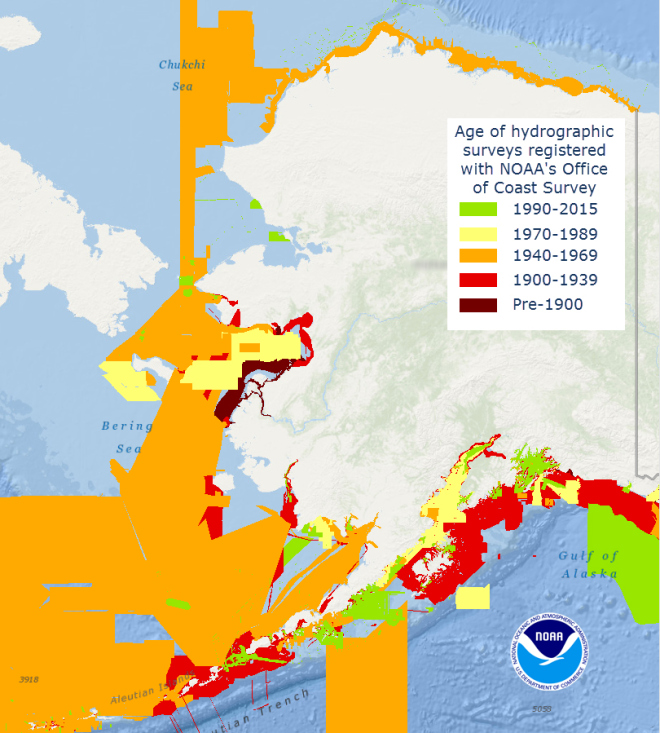
Alaska’s nautical charts need to be updated — we all know that. The diagram below shows the vintage of survey data currently used for today’s charts in Alaska. The graphic includes all surveys done by NOAA’s Office of Coast Survey (and its predecessors), and some limited data acquired by other agencies, i.e., the U.S. Coast Guard. Areas that are not colored in have never been surveyed or have data acquired by another source — from Russia or Japan, for instance — before the U.S. was responsible for charting in that area.

Vintage of Alaska survey

What are the differences between data collected in 1900, 1940, or 1960? Let’s take a look at a…

Brief Historical Sketch of Survey Technologies

Nautical charts have a lot of information, but mariners especially are concerned with two major components: water depths (known as “soundings”) and obstructions (like underwater seamounts or wrecks).

Different eras used different technologies to find, measure, and…

View original post 1,356 more words

Posted in Boating Safety | Leave a comment

Tips & Hints For Preventing or Dealing With Oil and Fuel Spills

Oil spill prevention kit

Free Small Oil Spill Prevention Kit Contents

Yes recreational boaters on average behave responsibly, but accidents do happen and nobody wants to see an oil spill gathering around their boat in the marina.   Small Oil Spill Kits are being given out free to help boaters keep the water clean and to raise awareness of the need to be always vigilant.

To help boaters prevent oil spills, Free Small Oil Spill Prevention Kits are being given out by the Washington Sea Grant Program, U. S. Coast Guard and the U. S. Coast Guard Auxiliary.

The free Small Oil Spill Prevention Kits have a Bilge Sock to put in the bilge to soak up any oil or fuel spills that make it into the bilge.  There are also gloves and a trash bag and information on how to avoid a fuel or oil spill and what to do if you have a spill or see one.

Continue reading

Posted in Boat Maintenance, Boating Safety | Tagged , , , , | 6 Comments